

Voice quality management in the PSP call center
AI-translated from the Chinese original · editorially reviewed

In a fast-moving healthcare industry, patient support services have become key to improving patient satisfaction and treatment efficiency. PatientsForce's next-generation intelligent medical management system is built around the Patient Support Program (PSP) governance process, integrating and upgrading the MediPASS case management platform together with the telephony system. Voice recognition technology drives quality assurance and a better customer experience, while real-time data analytics supports patient workflow management and drug safety monitoring.
Closing the call center governance gap with AI
Traditional medical call center systems have long struggled to bridge patient management and drug safety monitoring. Quality oversight has depended on supervisors listening to recorded calls or reviewing customer feedback surveys — methods that are both time-consuming and costly. The PatientsForce MediPASS management system fundamentally changes this model: an artificial intelligence (AI) risk-detection engine, combined with system LOG data, helps supervisors quickly spot conversation quality risks and manage operational efficiency, while keeping drug safety governance workflows intact.
Through the STT module, speech is converted into text and distilled into key-point summaries, extracting content insights from every customer interaction — especially valuable when processing patient–agent interaction data:
- Live call transcription and automatic tagging: STT captures and analyzes call content as the conversation unfolds, helping agents summarize their work, while database-backed AI Copilot technology surfaces suggested responses.
- Integrated data analytics: By pulling data from multiple sources, including the MediPASS platform and interaction history, AI delivers a more complete view of patient needs and issues.
- Voice AI quality management: With Voice AI, the system monitors the tone, sentiment, and overall quality of conversations, helping identify potential dissatisfaction or confusion before problems escalate, and applying weighted scoring to caller satisfaction and agent professionalism.
A real-time dashboard for risk prediction
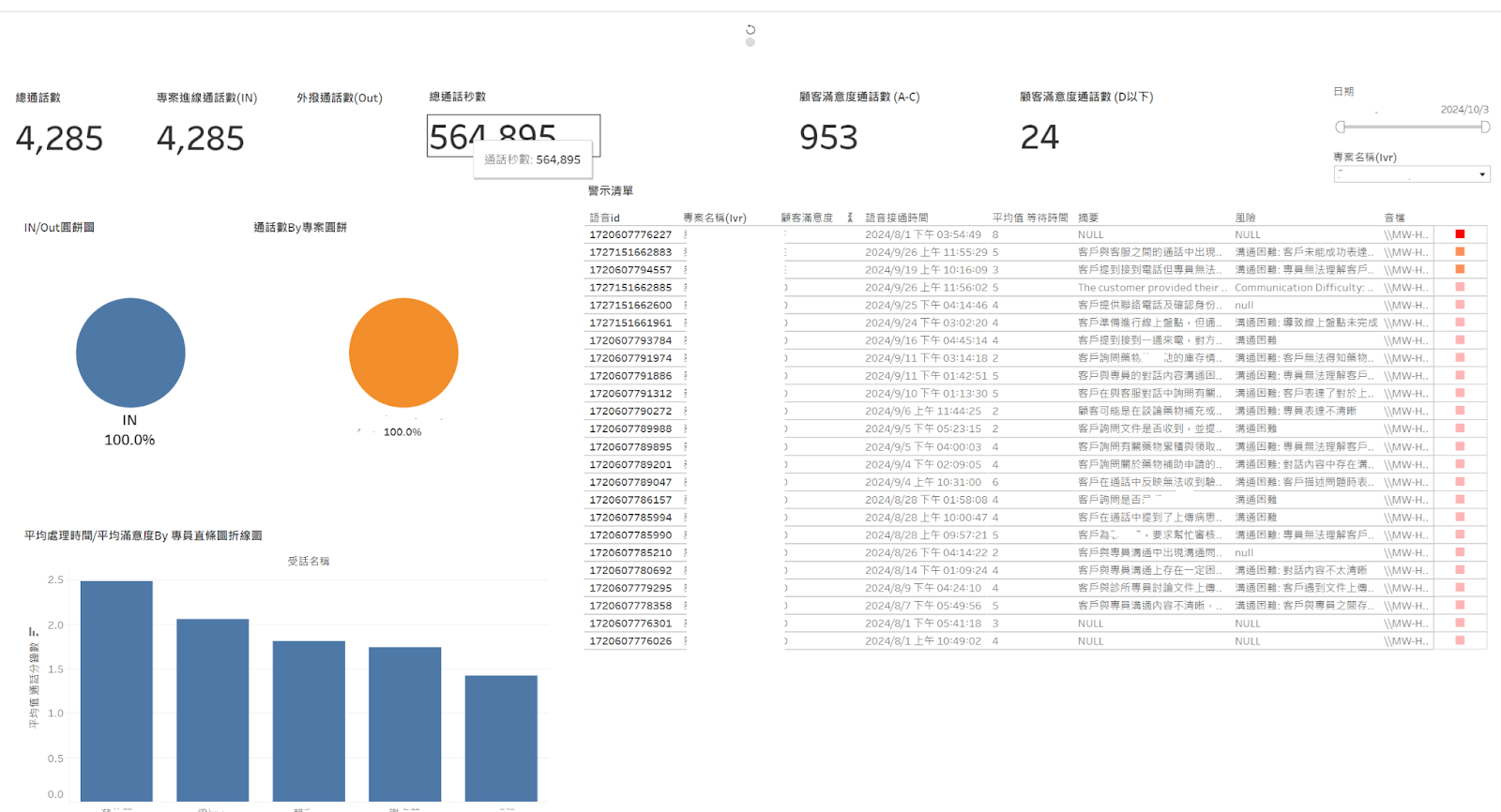
One of the most impactful innovations in the PatientsForce system is the real-time service operations dashboard. Designed for at-a-glance visibility, the Dashboard lets managers make rapid decisions and understand emerging risks, including sensitive conversations, key-point summaries, and overall conversation satisfaction. Managers no longer need to rely on post-call sampling or case-by-case reviews to judge performance. Instead, actionable insights and essential quality metrics are available while calls are still in progress.
Medical call centers face persistent operational efficiency challenges, particularly around metrics such as first-call resolution (FCR) and average handle time (AHT). The Voice AI system helps identify common issues early and streamlines the support process, meaningfully improving these key indicators.
Beyond call analytics, PatientsForce equips agents to resolve issues proactively and analyzes the treatment journey, ensuring patients receive timely reminders or interventions — for example, predicting follow-up visit windows and aligning with physician instructions — to deliver more personalized support.
From medication management to support for healthcare institutions
PatientsForce's intelligent medical management technology is applied not only to high-specification PSP services; it also provides solutions for outsourced patient management in clinical trials and program-based patient services for healthcare institutions — for example, scheduled or seasonal patient outreach services, support schemes for family physician programs, and enrollment services for vaccination or cancer screening.
─ Wang Hao-Chun, PatientsForce, Media-WIND Health Group (MWHG)