

Financial toxicity and its hidden impact on cancer patients: here is what actually helps ease the burden
AI-translated from the Chinese original · editorially reviewed

Reprinted with permission: Pharmascan
Financial toxicity mostly refers to the excessive financial stress caused by cancer treatment. The moment a cancer patient decides to receive a new drug therapy, the cost pressure and burden of treatment become a serious problem for many families. How to effectively lighten the financial load and defuse the crisis financial toxicity creates is a question worth serious thought.
As technology advances, digital tools can let patients clearly manage their personalized medication regimens, and medical assistance can let patients pay heavy drug costs in installments, buying time to arrange funds — so cancer patients can pursue treatment while preserving their original quality of life. Comprehensive solutions like these help pharmaceutical companies reduce patients' financial burden and sharpen a drug's market competitiveness, while also strengthening the company's image and the trust patients place in it — a win-win-win treatment environment. This is what actually helps ease the burden on cancer patients!
Financial toxicity: new cancer drugs — the hidden worry beneath the white coat
Financial toxicity has no formal definition, but it mostly refers to the excessive financial stress caused by cancer treatment. Although some cancers have trended toward becoming chronic conditions in recent years, many cancer types still require innovative drugs or technologies during treatment, and the new technologies used to treat these diseases are usually priced extremely high. Without health insurance, patients must cope not only with the stress of treating the disease but also with enormous medical bills, taking a repeated toll on quality of life and mental health. As life expectancy in Taiwan lengthens and cancer treatment costs keep climbing, the issue of financial toxicity deserves growing attention.
Financial toxicity is shaped by the healthcare system
The severity of financial toxicity varies with each country's economic development, healthcare system, insurance coverage, and personal disposable income. Take the US: its market-oriented healthcare system means not everyone has health insurance, plans differ widely, and out-of-pocket amounts vary enormously — every bill can feel like a court verdict, since you only learn how much you owe when it arrives. For those with little capacity to absorb the hit, a financial crisis can erupt.
One study also shows that out-of-pocket costs for Americans have grown from US$1,800 to US$2,900 a month — and that only counts consultation fees, not other derived expenses such as drugs and tests. On top of that, the US is vast, so patients may bear high additional travel costs to reach care, and that still excludes income lost to taking leave for appointments.
By contrast, in Taiwan many healthcare items are paid for by the NHI, which has always operated with a social-welfare orientation. The NHI covers not only consultation fees but many drugs, surgeries, and tests, which — compared with the US — substantially reduces the financial burden on the public. Whereas US commercial insurance can create healthcare inequality for particular groups (racial minorities, the economically disadvantaged), Taiwan's system is relatively straightforward in this respect, with high access to medicine, convenient care, and shorter travel distances than in the US — so in theory the risk of financial toxicity should be lower.
How different national healthcare systems and institutions shape financial toxicity: America's market-driven system and uneven insurance can expose individuals to higher medical financial risk, while Taiwan's comparatively robust NHI lightens the public's burden and lowers the risk of financial toxicity.
Can financial toxicity exist even in Taiwan, where NHI coverage reaches 99%?
Taiwanese households pay a higher share of medical costs out of pocket than those in other countries. According to the 2021 NHE report from the Department of Statistics, Ministry of Health and Welfare, household out-of-pocket medical spending in Taiwan was NT$418.3 billion, or 29.3% of total healthcare spending of NT$1.4264 trillion. Measured as the household share of current health expenditure (public sector + corporate + household out-of-pocket + private health insurance administration), Taiwan stood at 31% in 2021, versus 26% in South Korea — which also has mandatory universal health insurance — and 11% in Germany. Although the figures cannot account for what individuals recover from commercial insurance, meaning actual burdens may be lower, this is still an average across the whole population, not a measure specific to cancer patients.
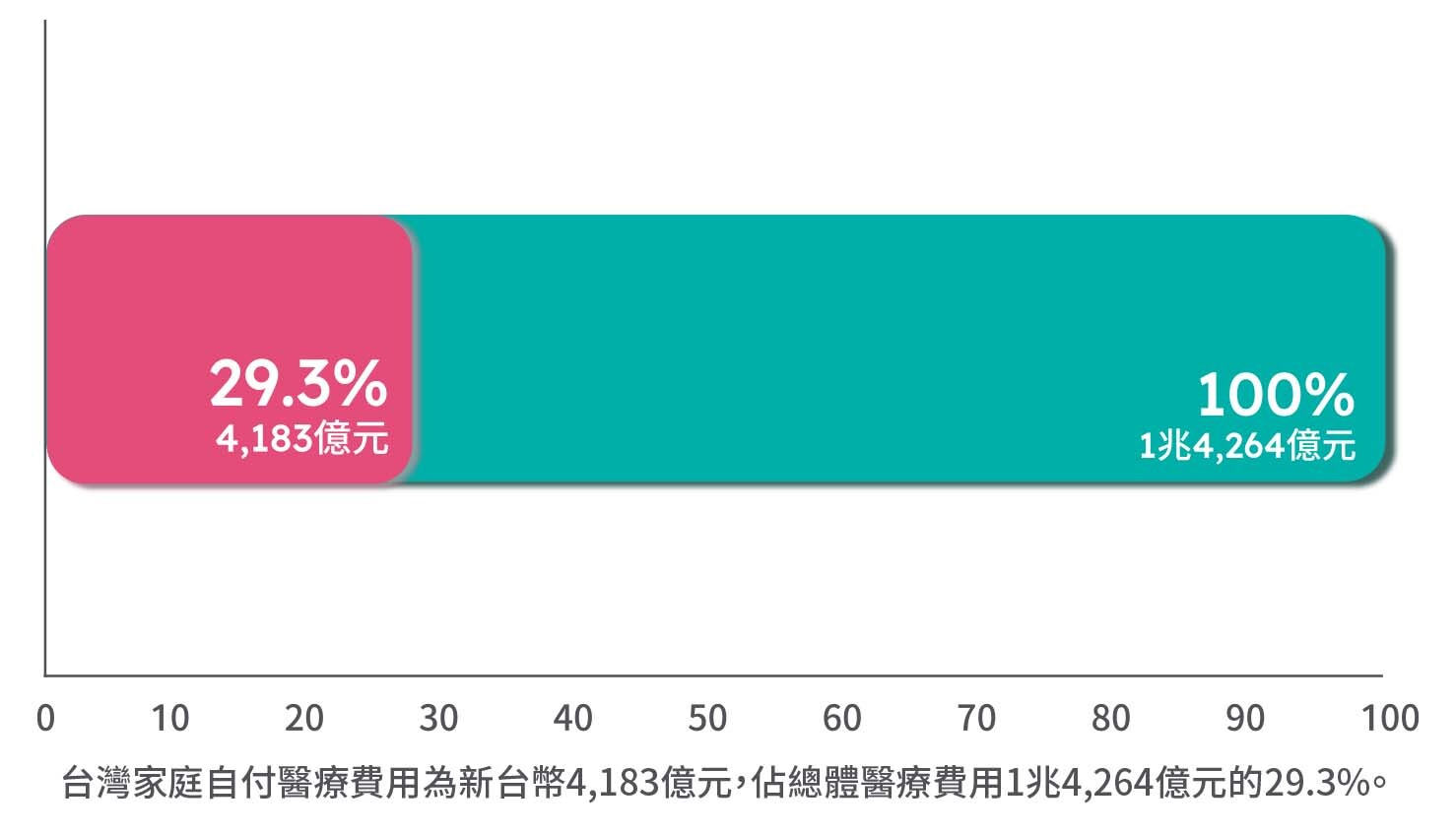
Information on financial toxicity in Taiwan remains scarce (additions welcome), and there is still no international consensus on how to measure it. But it is beyond dispute that cancer drugs — especially new ones — are broadly expensive, and payers must face enormous financial pressure to fund them. With limited budgets, NHI coverage restrictions may tighten, leaving some patients unable to obtain necessary treatment, while healthcare institutions may find themselves squeezed, leading to a retreat from cancer care services.
As new treatments, tests, and diagnostic tools keep emerging while NHI funding growth stays limited, full coverage is far from guaranteed. Paying out of pocket is one way to enjoy new technology — but it can raise the risk of financial toxicity.
Despite the advantage of NHI coverage reaching 99%, financial toxicity remains a real possibility in Taiwan. Taiwanese households shoulder a higher share of out-of-pocket medical costs than other countries, and concrete data on financial toxicity are lacking. The high prices of cancer drugs — new drugs especially — put enormous financial pressure on the NHI as payer. With limited funds, coverage may be restricted, leaving some patients without access to necessary treatment and putting healthcare institutions in difficulty. As new technologies keep arriving and NHI funding growth stays limited, the system cannot fully absorb their costs. Self-payment is one option, but it can raise the risk of financial toxicity. Therefore, the financial toxicity problem under Taiwan's NHI system deserves attention and solutions, to ensure people can obtain appropriate, affordable care.
Financial toxicity tends to strike these people
Financial toxicity is especially likely to hit particular cancer patients — the young and those with lower incomes. Younger patients have relatively little in savings, and taking leave for treatment plus the toll of physical discomfort can add further costs. A Japanese survey focused mainly on gastrointestinal cancers (colorectal, gastric, esophageal, and others) found that younger age or lower saving capacity may be linked to severe financial toxicity, underscoring that financial toxicity in younger groups deserves particular attention.
The study also found that people without stable jobs, or who — to avoid steep medical bills — dip into savings, cut recreational spending, or simply skip picking up prescriptions or reduce their doses, may suffer more severe financial toxicity. This again underscores that financial toxicity in younger groups deserves particular attention.
The severity of financial toxicity may look like a function of personal finances, but in practice, cancer type, disease severity, age at diagnosis, and whether diagnostics and drugs are covered by insurance are also linked to the impact financial toxicity has on an individual.
Take Taiwan's NHI as an example: many liver cancer patients are diagnosed at an advanced or terminal stage, when treatment options are already quite limited. Chemotherapy plus targeted drugs is one approach, but these drugs (or drug combinations) do not work for everyone. Cancer immunotherapies have gradually arrived, but because the payer judged their results to fall short of expectations, new patients are no longer covered — those who want them must come up with hundreds of thousands of NT dollars a month on their own.
Other cancers such as lung and urinary tract cancer may qualify for coverage under specific conditions, but yearly quotas are limited: patients must test for specific genes and endure a cumbersome application process. Even after approval, coverage can be withdrawn if the drug shows no improvement within a set period — an emotional grind, layer upon layer, for patients. And if they wish to continue, the cost comes out of their own pockets.
Such combined financial and psychological pressure can push patients to postpone or refuse necessary treatment, worsening the disease and further raising the risk of financial toxicity. This vicious cycle can appear not only in liver cancer but also in head and neck cancer, metastatic breast cancer with poor prognosis, and reproductive tract cancers.
Possible remedies for financial toxicity?
For individuals hoping to ease financial toxicity and break the vicious cycle, holding additional insurance and suitable installment products beyond the NHI is one approach that may relieve the financial strain.
Still, as ever more novel and expensive medical technologies come to market and NHI funding growth stays limited, the items and scope of coverage will not always keep pace with international trends. New technology is not necessarily the best treatment, nor right for every patient — but hospitals can help patients understand treatment costs in advance and offer financial counseling, while physicians can lay out treatments inside and outside the coverage envelope, their pros and cons, and the financial pressures they may create, helping patients prepare ahead of time.
As digital technology advances, smartphone apps can manage personalized medication regimens, laying out complex dosing cycles, costs, and dates clearly — bringing convenience to cancer patients' lives.
Beyond that, with NHI funding limited, if pharmaceutical companies support drug-cost installment plans, self-paying cancer patients can use medical assistance programs to pay their heavy cancer drug bills in installments — maintaining their pre-illness quality of life while under treatment. The lift in spirits that comes from lighter cost pressure also aids the treatment itself, and in the virtuous cycle of reduced financial toxicity, pharmaceutical companies and healthcare professionals quietly earn a positive image and trust!
-Provided by PatientsForce
The content of this article has been licensed by Pharmascan to PatientForce™ (Media-WIND Communications Co., Ltd. / Tax ID: 27903403); its intellectual property rights are jointly owned by PatientForce™ and Pharmascan in accordance with the law. If you believe this article raises any infringement concerns, please contact the relevant department of our company by email and we will respond as soon as possible.