

Research spotlight: how a growth hormone Patient Support Program (PSP) helped caregivers
AI-translated from the Chinese original · editorially reviewed
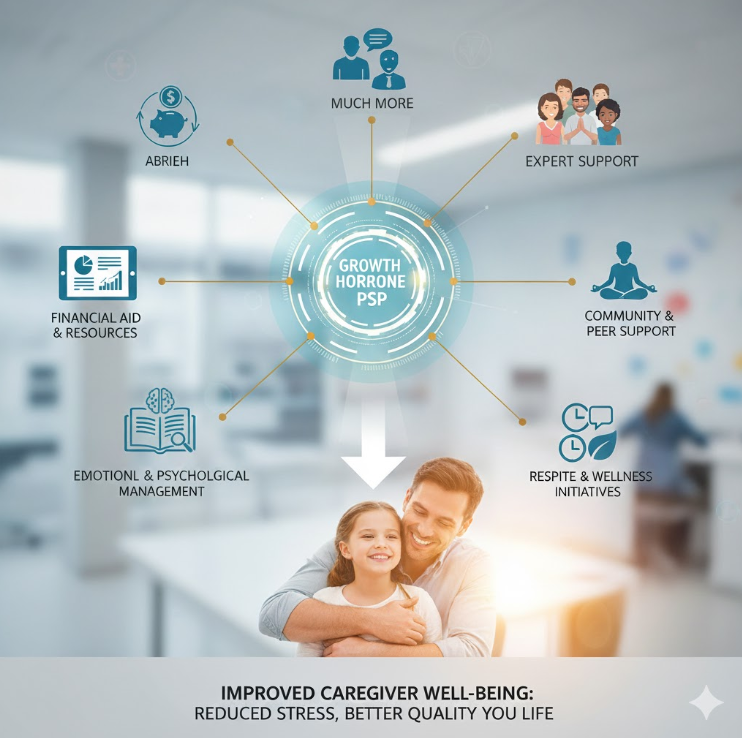
Recombinant human growth hormone (r-hGH) therapy has long faced adherence challenges in pediatric endocrinology. A paper recently published in Frontiers in Endocrinology (April 2025) evaluated the TUITEK® Patient Support Program (PSP), which uses personalized coaching to help the primary caregivers of children receiving r-hGH.
The PSP design and the Taiwan arm of the trial
The TUITEK® PSP combines behavior change theory (COM-B) with personalized assessment, targeting four key factors: parenting-role stress, medication knowledge, feelings about treatment, and confidence in self-injection. Nurses provide in-depth support by phone, using motivational interviewing to give high-risk caregivers one to five dedicated follow-up sessions. Beyond the core intervention, the Taiwan program added dimensions such as the child's emotional burden, perceived necessity of treatment, social support, and the daily burden of treatment, conducted as an observational study.
Study design and the Taiwan cohort
Three countries (Argentina, South Korea, and Taiwan) ran before-and-after comparisons in parallel, with the PSP and its evaluation targeting high-risk caregivers only. In Taiwan, 99 high-risk parents enrolled and received an average of 366 days of long-term hotline-based PSP support, a participation rate far higher than in the other countries.
Key findings
Across the full analysis of 409 caregiver parents, every behavioral dimension improved significantly, with clear reductions in treatment-related perceptions, medication confidence gaps, psychological stress, and anxiety — the most pronounced gain being caregivers' medication knowledge.
Highlights from the Taiwan cohort
- High baseline emotional stress: As many as 80.8% of Taiwanese caregivers started out high-risk; after the PSP, 75% shifted to low-risk.
- 100% improvement in treatment understanding: Every caregiver classified as high-risk on treatment understanding and disease knowledge ultimately shifted to low-risk.
- Greater confidence in self-injection: 50.8% of Taiwanese parents improved after the PSP intervention, though slightly below the other countries.
- Lower treatment-related anxiety: The share of high-risk caregivers fell by 73%.
- Taiwan's added dimensions also improved significantly: the child's emotional burden (84.0% improved), perceived necessity of treatment (75.0% improved), social support (62.5% improved), and treatment-related burden (71.8% improved) all declined markedly.
The study confirms that the TUITEK® PSP effectively strengthens Taiwanese caregivers' psychological adjustment, knowledge uptake, and caregiving confidence. Taiwanese parents carried the highest emotional stress, yet showed marked improvement under the program's long-term, individualized intervention — a powerful strategy for continuously improving children's treatment adherence and the quality of family care.
It should be emphasized that this study focused on behavioral and psychological indicators and did not directly link to clinical treatment completion rates or growth outcomes. Future work will need to incorporate electronic treatment records to examine how the intervention affects patients' long-term health outcomes.
Source
This article is a professional interpretation and simplified explanation, produced with Gemini Pro 2.5, of "The TUITEK® patient support program improved caregiver-related behaviors on growth hormone treatment adherence," published in Frontiers in Endocrinology.
Koledova, E., Su, P.-H., Chen, Y.-J., Assefi, A., Debicki, M., Cooke, D., Jheeta, A., Jones, A. B., & Moon, J. E. (2025). The TUITEK® patient support program improved caregiver-related behaviors on growth hormone treatment adherence. Frontiers in Endocrinology, 16.