

Media-WIND Care Companion and Taiwan Corning Social Welfare Association promote healthy-aging planning lecture series
AI-translated from the Chinese original · editorially reviewed
Care Companion leads cross-sector collaboration to build a blueprint for secure aging
In a rapidly aging society, helping seniors and their families face the second half of life with confidence has become a new frontier for care services. The "Secure Aging, Wise Living" lecture series — organized by the Media-WIND Care Companion home care agency and co-organized by the Taiwan Corning Social Welfare Association and Mega Bank — has held four sold-out sessions since launching in July, each drawing around 10-20 enthusiastic participants. Built on the core value of "Care Companion — from caregiving to companionship, from now into the future," the series combines expert talks, interactive exchange, and cross-sector collaboration to turn later-life planning from an abstract idea into a practical blueprint for living.
Highlights from the four sessions
July 26 — Retirement planning, asset management, and trusts for middle-aged and older adults
The opening session centered on financial security, with Cheng Chih-Yang, attorney and chairman of the Taiwan Corning Social Welfare Association, joined by wealth management experts from Mega Bank to analyze the strategies and key considerations of retirement fund allocation and trust management. Drawing on real cases, the speakers showed how an "elder care trust" can balance a senior's living and care needs, helping families preserve financial autonomy and dignity in later life.
The audience responded enthusiastically with questions such as: "Can I set up an elder care trust if I only own one house?" "Can trust funds be accessed at any time?" "Will my family think I don't trust them?" The speakers addressed each in turn, emphasizing that a trust is not about distrust but an institutional design that makes care arrangements more dependable — with flexible terms for purposes and disbursement conditions to ensure funds go where they are truly needed.
Attorney Cheng further reminded attendees that the earlier later-life planning begins, the fewer disputes arise later. As the session closed, many participants said they had gained a great deal: "It turns out a trust is not just a financial tool, but an arrangement that gives the future security and dignity."
August 23 — Goodbye, back pain: back-support wearables, prevention, and relief of lower back pain
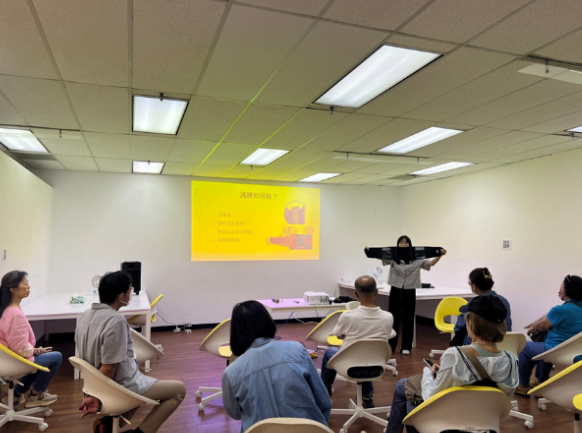
The second session returned to health, focusing on back pain and muscle loss, both common among seniors. A physical therapist explained how to choose and correctly use back-support devices, demonstrated stretches and posture adjustments to relieve lower back pain, and stressed the importance of preventive back care.
During the class, a participant in his seventies shared that he had suffered chronic back pain for years, assuming it was simply aging — only to realize in class that prolonged sitting and bending habits were the culprit. He asked with a laugh, "Do heat patches work?" The instructor quipped back, "Patches are only temporary comfort — real back care comes from moving." Attendees then rose to practice simple stretches together with the therapist, filling the room with lively interaction. That exchange, and that scene, became the day's most practical and warmest health reminder.
September 20 — Asset trusts, elder care trusts, and voluntary guardianship
The third session returned to legal protections, with Attorney Cheng and the bank's trust specialists taking the stage together again, using vivid case studies to show how institutionalized arrangements let elders plan care and medical decisions in advance, avoiding family disputes and financial risk.
Questions poured in from the floor, including "Can a home be placed into an elder care trust?" and "What if family members disagree?" The specialists replied that with proper assessment of assets and needs, a home can indeed be placed into an elder care trust, turning real estate into a stable source of care funding.
The second half focused on fraud prevention and financial safety for seniors. The bank's trust specialist warned that scams keep evolving, with endless cases of fraudsters posing as relatives or government agencies — what elders need most is institutional protection. Beyond managing assets, he noted, a trust can build in anti-fraud safeguards such as multi-step review mechanisms and designated disbursement conditions, preventing seniors from being lured into withdrawals or transfers.
As the speaker put it: "A trust is not just a financial tool — it is the most practical safety net for the second half of life." Many attendees remarked, "I never knew a trust could prevent fraud. I learned something new and feel more at ease."
October 18 — Let love breathe: respiratory therapy and autonomous end-of-life choices
The fourth session turned to the final chapter of life. A senior respiratory therapist drew on clinical experience to share the core spirit of the Patient Right to Autonomy Act, guiding attendees to consider how to make choices for their own farewell. Through real examples, the speaker showed that a good death is not only a medical decision but a considerate arrangement for one's own dignity and one's family's burden.
One attendee asked, "Can I decide in advance not to be intubated?" The speaker explained that by completing advance care planning consultation under the Patient Right to Autonomy Act, one's wishes can be clearly documented so that family and the medical team respect them by law. Another participant shared: "This class gave me the courage to imagine my own departure, and taught me how to better accompany my family."
The session closed in a gentle atmosphere, with participants describing it as not just a health lecture but a journey of reflection on life and love — a reminder that choosing how to say goodbye is also the most tender way to care for one's family.
The cross-sector spirit of Care Companion
This series was more than knowledge-sharing in a single field; it embodied Care Companion's philosophy of cross-domain integration with people at the center. By partnering with a welfare association, a bank, and other allies, the series connected four dimensions — health, law, finance, and daily care — into a comprehensive support network for later life. This collaborative model gives seniors and families professional advice and emotional support at once, realizing a new value for long-term care built around companionship.
Looking ahead to the final two sessions: from legacy to living well
The "Secure Aging, Wise Living" series continues toward its two year-end finale sessions:
November 22 — Inheritance, wills, and estate distribution: a senior attorney unpacks the inheritance system and the essentials of drafting a will, helping attendees plan ahead so that love and assets pass on smoothly.
December 20 — Caring for older adults: housing arrangements and related care issues: combining financial planning with long-term care practice to explore senior living and home care strategies, bringing the series to a fitting close.
Across this full year of six lectures, "Care Companion" is more than a service brand — it is an attitude: accompanying older adults through every stage of life with wisdom, security, and dignity.
Care Companion — making caregiving not just labor, but warmth and trust in everyday life.